
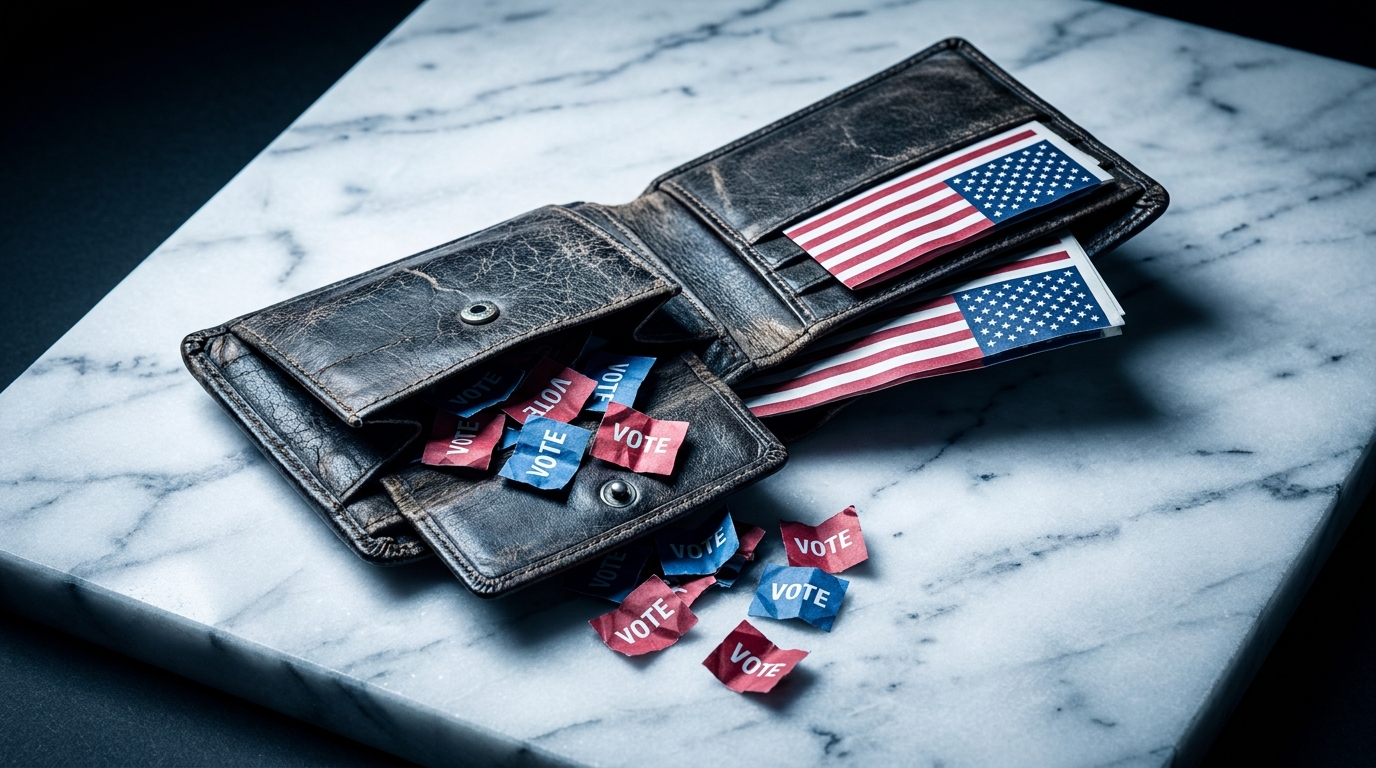
Voting with your wallet means directing your spending toward companies aligned with your political and ethical values - and away from those that aren't. Research shows consumer boycotts have real economic consequences: Bud Light lost roughly 26% in U.S. sales after a 2023 political controversy. This article explores how political consumer spending works, whether individual choices drive change, what the data says about collective buying power, and how tools like ShopHowYouVote.com make it easy to identify brand political leanings before checkout.
What does it really mean to "vote with your wallet"? At its core, it's the idea that consumer
spending is a form of political expression - one that's arguably more consistent than the act of
casting a ballot every two or four years. Every time you buy a product, you're quietly funding the
company behind it, and that company may be using a portion of its profits to support political
candidates or causes you'd never voluntarily back at the voting booth. Spoiler: many of them are.
The data backs this up more than most people realize. According to a landmark study by Schoenmueller,
Netzer & Stahl at Columbia Business School, brand polarization in America has increased dramatically
over the past decade - consumers now consciously associate brands with political parties, and those
associations measurably affect purchasing behavior. Meanwhile, the Harris Poll's 2025 Consumer
Spending and Political Values Survey found that over 60% of American adults changed at least one
purchasing decision based on a company's political stance in the past year alone. That's not a
fringe movement - that's the mainstream having a very quiet, very effective revolution.
The Federal Election Commission (FEC) reports that corporate PACs spent over $3.8 billion in the
most recent election cycle. Where do you think that money comes from? It didn't fall out of the
sky. It came from product sales, subscriptions, and consumer transactions - the everyday purchases
of people who, in most cases, had absolutely no idea their money was going there.
Here's the empowering flip side: unlike your single vote in a national election, your spending
power is exercised dozens of times per week. That's dozens of opportunities to either fund the
opposition or reinforce your own side.
Research shows sustained boycotts can cause 226% revenue drops for targeted brands
Brand-political associations now form within weeks of a controversial corporate decision
Timothy Werner (UT McCombs) confirms that coordinated, sustained consumer activism - not
one-time outrage - is the mechanism that actually changes corporate political behavior
Consumers who research brand politics before buying report higher purchase satisfaction
and stronger brand loyalty to aligned alternatives
So we've established that wallet voting is real, measurable, and happening at massive scale.
Now the practical question: how do you actually do it without spending three hours on Google
every time you need to buy dish soap?
The good news is that the infrastructure for political consumer action has never been more
developed. Tools, apps, and databases have emerged specifically to translate the dense, jargon-
heavy world of FEC campaign finance filings into digestible, actionable information for everyday
shoppers. The question is just knowing which ones to use - and how to build the habit.
According to Timothy Werner's research at the University of Texas McCombs School of Business,
political consumer activism is most effective when it's sustained, coordinated, and grounded in
specific corporate behaviors rather than vague ideological impressions. Knowing that a company
donated $400,000 to a specific candidate's PAC is far more actionable than just "feeling like"
a brand leans a certain way. Feelings are a starting point. FEC records are the receipts.
FEC.gov is the gold standard for raw verification - every corporate PAC contribution above a
minimal threshold is publicly disclosed. But it's dense, bureaucratic, and not exactly designed
for someone standing in a grocery aisle trying to decide between two cereal brands. That's
precisely the gap that consumer-facing platforms like ShopHowYouVote.com step in to fill.
Here's what makes political shopping sustainable rather than exhausting:
Start with your highest-frequency purchases - grocery staples, gas, coffee, and streaming
subscriptions are where the most consistent political funding exposure lives
Build a personal "approved" brand list using a research platform and reference it quickly
Switch one category at a time - overhauling your entire shopping cart overnight leads to
burnout and backsliding, not lasting alignment
Remember: even redirecting 30% of spending to aligned brands has real aggregate impact
when multiplied across millions of like-minded consumers
The Harris Poll data is unambiguous: Americans who engage in deliberate political shopping report
feeling more civically empowered - not more exhausted. That's the tell. Values-based shopping
is a habit with compounding returns.
1. Schoenmueller, V., Netzer, O., & Stahl, F. - 'The Polarization of Brands,' Columbia Business School Research
2. Harris Poll - 'Consumer Spending and Political Values Survey,' Harris Poll / Axios (2025)
3. Werner, T. - 'The Political Economy of Corporate Political Activity,' University of Texas McCombs School of Business
4. FEC.gov - Campaign Finance Data, Federal Election Commission