
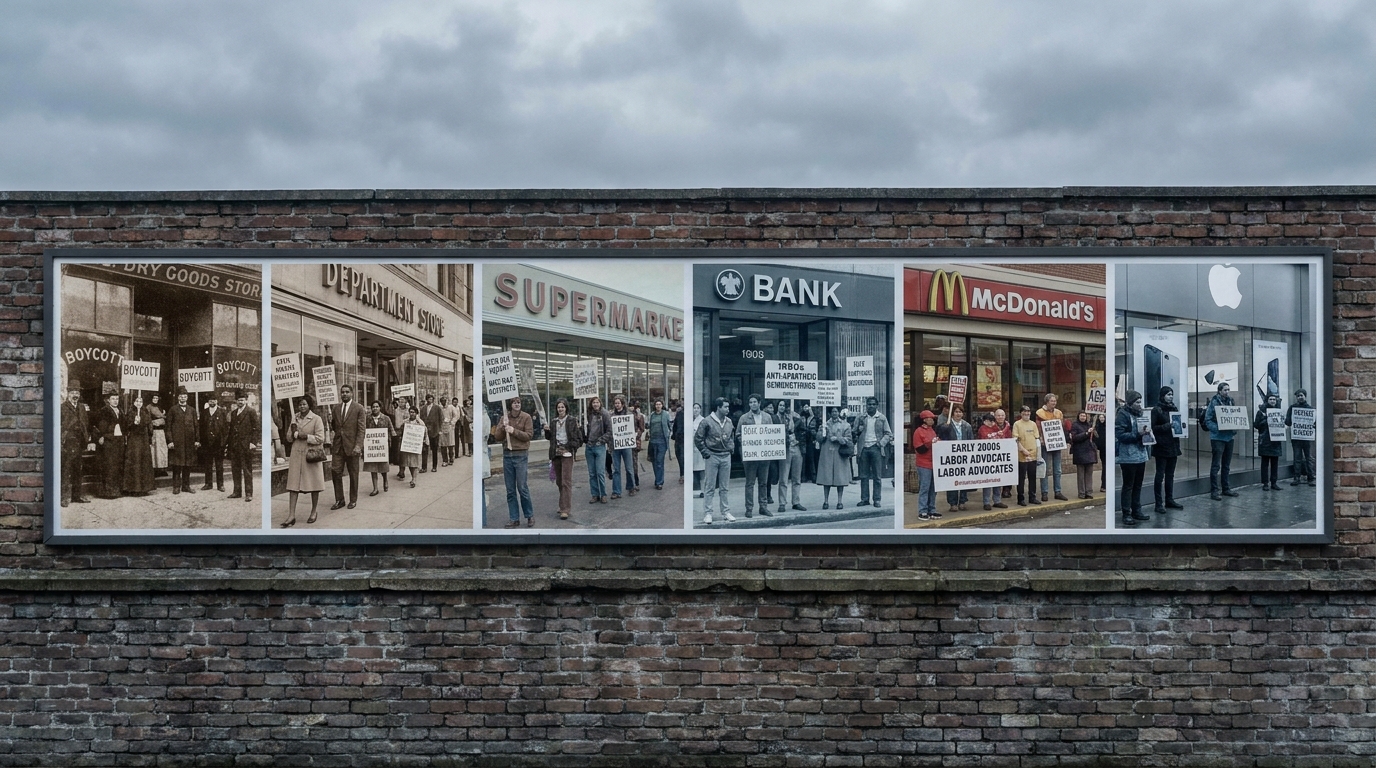
Consumer boycotts have shaped American history - from the Montgomery Bus Boycott to the Bud Light collapse of 2023. This article chronicles the six most impactful corporate boycotts in U.S. history, examining what triggered each one, how consumers organized, what the financial and policy outcomes were, and what today's political shoppers can learn from these battles. With modern tools like ShopHowYouVote.com, mounting an effective, informed, values-based boycott has never been more accessible or more powerful.
Consumer boycotts have shaped American history more profoundly than most people recognize -
and understanding the historical record isn't merely academic nostalgia. It's the most actionable
research available for modern political consumers who want to understand precisely when boycotts
work, when they don't, and what specific conditions consistently determine the difference between
a cultural moment and an actual outcome.
The six most impactful corporate boycotts in American history, ranked by lasting measurable impact:
#1 - The Montgomery Bus Boycott (19551956)
The template for all successful consumer activism that followed. African American residents of
Montgomery boycotted the city's bus system for 381 consecutive days. A 40% revenue decline for
Montgomery City Lines combined with resulting litigation produced the Supreme Court ruling that
desegregated the buses. As historian David Garrow documents in "Bearing the Cross," it proved
sustained consumer withdrawal could produce constitutional-level change. Duration and organization
outperform initial intensity every time.
#2 - The United Farm Workers Grape Boycott (19651970)
Cesar Chavez and the UFW organized a national boycott convincing an estimated 17 million Americans
to stop purchasing grapes. Sustained economic pressure contributed directly to the first collective
bargaining agreements in American agricultural history. Specific demand plus multi-year discipline
produced what weeks of protest alone could not.
#3 - The Nestlé Infant Formula Boycott (1977present)
One of the longest-running global consumer campaigns in history. It produced the WHO International
Code of Marketing of Breast-milk Substitutes and forced repeated documented Nestlé policy changes.
Key lesson: institutional support (WHO, UNICEF) and international coordination can sustain a
boycott essentially indefinitely.
#4 - The South Africa Divestment Campaigns (1970s1990s)
A coordinated consumer and institutional investor campaign targeting companies doing business with
apartheid South Africa. OpenSecrets' analysis credits this as a documented case where sustained
consumer and investor pressure simultaneously changed corporate behavior and government policy.
#5 - The Bud Light Boycott (2023present)
The fastest major-scale corporate revenue impact of any digital-era consumer boycott. Axios' 2024
post-mortem found the total annual revenue impact at approximately $1.4 billion, with market share
loss persisting through multiple subsequent quarterly earnings reports.
#6 - The Target Pride Merchandise Boycott (2023)
Conservative consumer pressure produced approximately $10 billion in market capitalization loss
over several weeks per financial reporting - a dramatic illustration of organized consumer activism's
market-value dimension even when direct revenue effects were more modest.
The historical record above teaches several empirically grounded lessons that should inform every
modern political consumer's strategy. And the good news is that the modern political consumer has
structural advantages that every one of those historical boycott organizers would have found
transformative - and would almost certainly have used with devastating effectiveness.
What made the successful historical boycotts work, drawn from the Friedman academic framework
in "Consumer Boycotts: Effecting Change Through the Marketplace and Media":
Factor 1 - Specificity of demand.
The most successful boycotts always had clear, specific, and achievable demands. The Montgomery
boycott demanded desegregated seating. The grape boycott demanded union recognition. "Be less
political" is not a demand; it's a sentiment. OpenSecrets analysis of corporate behavior change
following boycotts consistently finds that campaigns with measurable, specific demands are far
more likely to produce verifiable corporate response than vague ideological discomfort campaigns.
Factor 2 - Duration decisively outperforms intensity.
Explosive boycott peaks that dissipate within six weeks rarely produce lasting corporate change.
The Friedman research documents this finding across decades of boycott case studies: moderate,
consistent pressure maintained over months and years outperforms dramatic, brief intensity in
producing actual corporate political behavior change every single time.
Factor 3 - Economic targeting, not reputational targeting.
Boycotts that directly impact quarterly revenue - affecting earnings reports, triggering analyst
downgrades, and reaching executive compensation benchmarks - produce corporate responses that
reputational damage alone, however embarrassing, never reliably generates. The Bud Light
experience confirms this: the revenue impact reached the level where it showed up in executive
compensation conversations, which is what ultimately produced genuine internal recalibration.
Factor 4 - Coordinated alternative spending is as important as the boycott itself.
The most powerful consumer activism isn't "don't buy X" - it's "don't buy X, buy Y instead."
Simultaneously punishing the target and rewarding the alternative creates a double economic
signal that is far more powerful than avoidance alone. This is precisely the insight that
ShopHowYouVote.com operationalizes: the verified aligned alternative is as important as the
boycott target, and finding it fast is what makes the behavior sustainable.
The historical boycotters who changed America worked with flyers and word of mouth. You have
verified FEC data, a smartphone, and platforms built specifically to make political consumer
action fast and sustained. Imagine what's possible when the tools match the ambition.
1. Garrow, D. - 'Bearing the Cross: Martin Luther King Jr. and the Southern Christian Leadership Conference,' HarperCollins
2. OpenSecrets - 'Corporate Boycott Financial Impact Studies,' Center for Responsive Politics
3. Axios - 'The Bud Light Boycott: A Financial Post-Mortem,' Axios (2024)
4. Harvard Business Review - 'When Do Consumer Boycotts Work? A Research Review'