
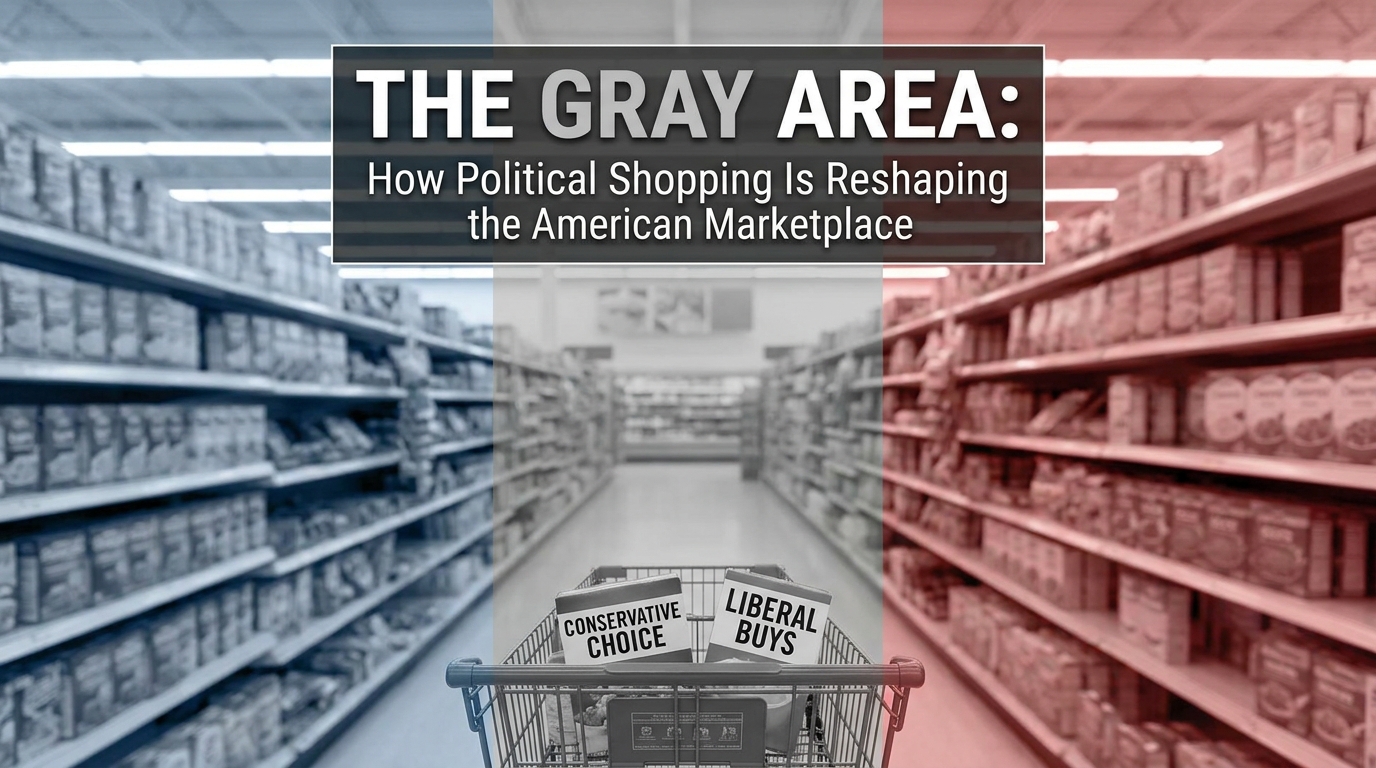
Political consumerism is no longer a fringe behavior - it's a mainstream economic force reshaping where Americans shop, eat, travel, and invest. This analysis examines the macro-level market trends driven by political consumer spending, including the growth of politically aligned brand categories, the rise of values-based retail startups, the financial impact of high-profile boycotts on quarterly earnings, and what market research firms predict for the future of political brand alignment. ShopHowYouVote.com sits at the center of this consumer revolution.
The traditional playbook for corporate political engagement was simple: maximize access by quietly cutting checks to candidates on both sides of the aisle while maintaining a completely neutral, apolitical public image. However, the unprecedented rise of organized, data-driven political consumerism has completely disrupted this historical paradigm, turning corporate campaign finance into a high-stakes arena of reputational risk. Today, as millions of Americans actively audit their shopping carts for partisan alignment, corporate political contributions are no longer hidden from public view. This newfound visibility has introduced serious financial consequences for businesses, forcing corporate boardrooms across the country to completely re-evaluate their long-standing partisan donation strategies to prevent sudden market share erosion and devastating consumer backlashes. This profound market shift is fundamentally altering corporate financial planning and risk management models. According to cutting-edge corporate research from Columbia Business School on "The Polarization of Brands," companies are finding that maintaining a highly conflicted political donation profile - where private PAC funding directly contradicts public social messaging - results in a significant measurable penalty to brand equity and long-term customer retention. As a direct result of this intense economic pressure, many consumer-facing corporations are beginning to pull back from hyper-partisan PAC funding entirely, choosing instead to restrict their political spending or redirect capital toward non-partisan, universally accepted community initiatives. This commercial disruption proves that when consumer spending shifts from an unvetted habit to a deliberate act of civic oversight, it establishes an unavoidable financial incentive for corporations to pull away from polarizing political games.
The institutional convergence of market research, brand strategy, and political science has led to a unanimous conclusion: values-based purchasing is no longer a temporary consumer trend; it is the foundation of an entirely new consumer economy. Experts tracking macroeconomic shifts observe that the modern marketplace is undergoing a structural realignment, with political identity rapidly replacing traditional metrics like brand loyalty and historical price sensitivity. As access to verified corporate campaign finance data becomes completely democratic, the checkout line has functionally transformed into a secondary voting booth, forcing a permanent evolution in how corporations must position themselves to survive in a hyper-aware, polarized consumer landscape. The long-term projections for this new economic reality point toward an increasingly segmented marketplace. As documented in the comprehensive Harris Poll report, "Political Consumerism in America: Scale, Trends, and Projections," demographic data indicates that younger, high-earning consumer groups show an unprecedented willingness to permanently sever ties with brands that fail to meet strict political transparency and alignment standards. Brand strategists predict that this generational shift will lead to the rise of explicitly ideological retail ecosystems, where corporations must choose between cultivating a dedicated, values-aligned customer base or facing financial irrelevance. Political scientists further argue that this consumer revolution represents a vital democratization of campaign finance oversight, giving everyday citizens a powerful, immediate mechanism to bypass paralyzed legislative bodies and directly penalize irresponsible corporate behavior through the everyday flow of global capital.
1. Schoenmueller, V., Netzer, O., & Stahl, F. - 'The Polarization of Brands,' Columbia Business School Research
2. Edelman Trust Barometer - 'Brand Trust and Political Consumer Behavior: Annual Report' (2025)
3. Harris Poll - 'Political Consumerism in America: Scale, Trends, and Projections' (2025)
4. Axios - 'How Political Consumerism Is Reshaping the American Marketplace' (2025)