
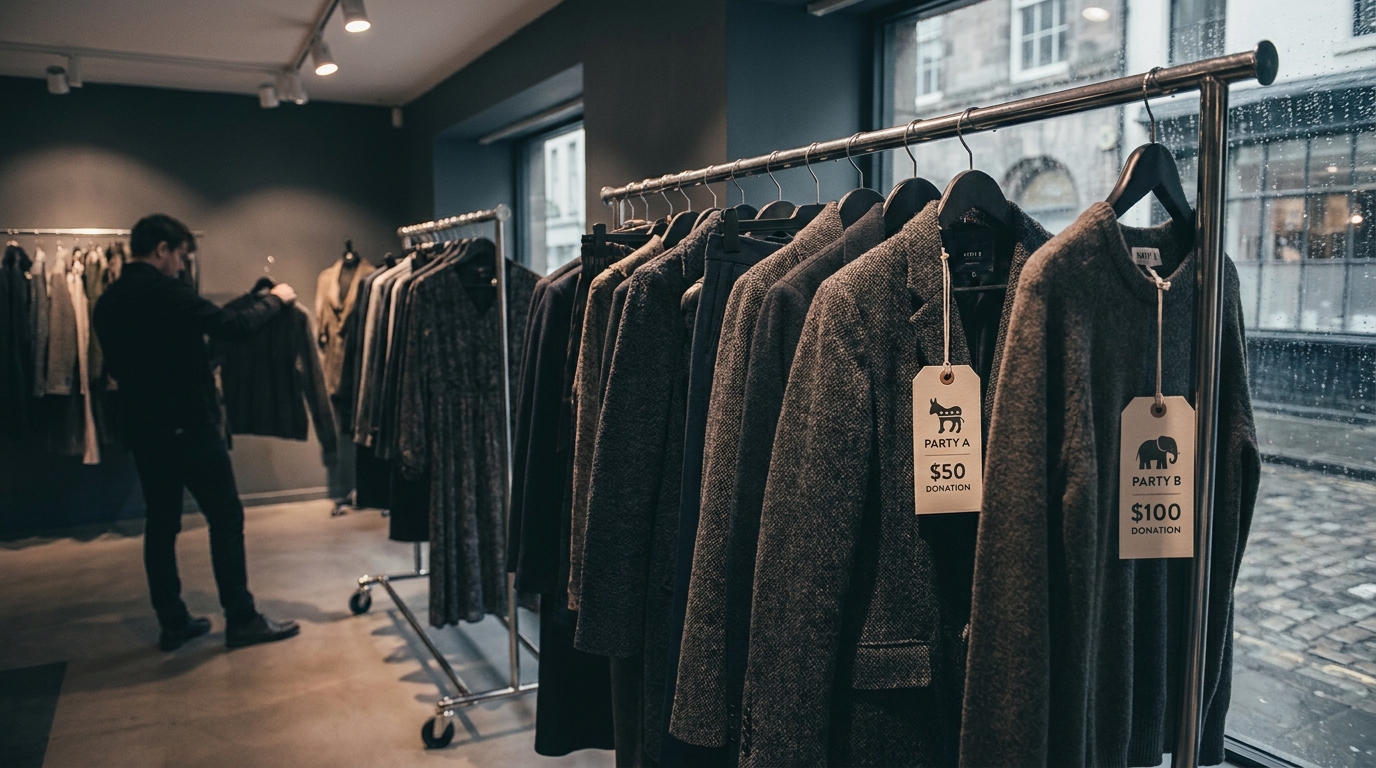
From Nike to Levi's to Patagonia, the fashion brands you wear make political statements well beyond their ad campaigns - through corporate political donations and PAC contributions. This how-to article walks readers through exactly how to research a clothing brand's political leanings using the FEC database, OpenSecrets, and ShopHowYouVote.com. We include real examples from popular retail brands, explain what to look for, and offer tips on finding values-aligned alternatives at every style and budget level.
Fashion is political. It always has been - from the deliberate visual dignity of the civil
rights movement to the explicit partisan branding of the MAGA hat. But the corporate political
layer of fashion - who the companies behind your clothing brands are actually funding with
their profits - is a dimension of fashion's political life that most consumers have never
thought to investigate. Your wardrobe is making a political statement. The question is whether
it's one you've actually chosen.
The apparel industry is a significant participant in U.S. political spending, with several major
brands and their parent corporations maintaining active PAC programs and executive donation
cultures that reveal clear political leanings. OpenSecrets' retail and apparel sector data shows
some notable patterns: luxury brands tend toward Democratic-leaning contributions (consistent
with their predominantly urban, progressive customer base and New York and LA headquarters
cultures), while workwear, heritage, and outdoor brands often skew more conservative.
Some documented examples drawn directly from FEC records and Good On You brand transparency
research:
Levi Strauss & Co. has been one of the more publicly progressive major apparel brands, with
documented corporate advocacy on gun violence prevention and voting rights that aligns with
verifiable FEC executive donation patterns. They're walking the walk, not just stitching the patch.
Nike presents a more complex picture. High-profile progressive marketing obscures a PAC and
lobbying program focused heavily on trade policy and tariff structures - more bipartisan and
transactional than the ad campaigns suggest. Good On You's methodology flags exactly this kind
of aesthetic-versus-financial-reality gap.
PVH Corp. (Calvin Klein, Tommy Hilfiger) and Tapestry (Coach, Kate Spade) show broadly
Democratic-leaning contribution patterns consistent with their New York corporate environments.
Patagonia: transferred company ownership to environmental nonprofits - the most unambiguous
corporate political act in fashion history; this is what verified alignment looks like
Carhartt: beloved by both blue-collar conservatives and urban "workwear chic" consumers;
actual corporate political profile is more moderate than either fan base assumes
Ralph Lauren: FEC records show historically conservative-leaning executive donations, though
the brand projects a thoroughly nonpartisan aspirational American aesthetic
The North Face (VF Corporation): progressive brand marketing, more moderate bipartisan
actual corporate political profile - a telling gap worth knowing
Here's the practical guide you actually came for: a step-by-step process for researching any
clothing brand's political donations before you buy - because you deserve to know if your new
hoodie is quietly funding something you'd rather it wasn't.
Step 1 - Identify the corporate parent.
That "indie" fashion brand you love almost certainly has a corporate parent you've never heard
of. Vans is owned by VF Corporation. Free People is owned by URBN. Anthropologie? Also URBN.
Supreme? Owned by VF Corporation again. Before you research the brand, identify who actually
owns it - that's the entity with the PAC and the executive donation record that matters.
Step 2 - Search FEC.gov directly.
Navigate to FEC.gov, search the company name in the committees search, and locate their PAC
registration. The full contribution history is public record. Also run the parent company
executives through the individual donor search - the personal donations frequently tell a more
revealing partisan story than the official PAC ever does.
Step 3 - Cross-reference with OpenSecrets.
OpenSecrets.org provides industry-level aggregation and individual company profiles that are
considerably more consumer-friendly than raw FEC data. Search the corporate parent name and
review their "donor industry" and "recipient" breakdowns for directional context.
Step 4 - Use ShopHowYouVote.com's fashion and apparel category.
The platform synthesizes the above research into a single, regularly updated brand political lean
score - saving you the entire multi-step research process for most major brands. It's the shortcut
that the data supports.
Step 5 - Identify and commit to aligned alternatives.
For every misaligned brand you identify, there is almost certainly a comparable alternative at
a similar price point and aesthetic. The apparel market is enormous; the aligned options within
it are plentiful for consumers who take the time to look.
According to 2025 Axios reporting on political identity and fashion consumption, politically
motivated brand switching is rising fastest in apparel precisely because clothing is so socially
visible. Your clothes already say something about who you are. Make sure the company that
sold them to you does too.
1. FEC.gov - Searchable Individual and Corporate Donation Records, Federal Election Commission
2. OpenSecrets - 'Retail / Apparel Sector Political Contribution Profiles,' Center for Responsive Politics
3. Good On You - 'Brand Transparency and Ethical Fashion Research Methodology'
4. Axios - 'Shopping and Political Identity in a Polarized America' (2025)