
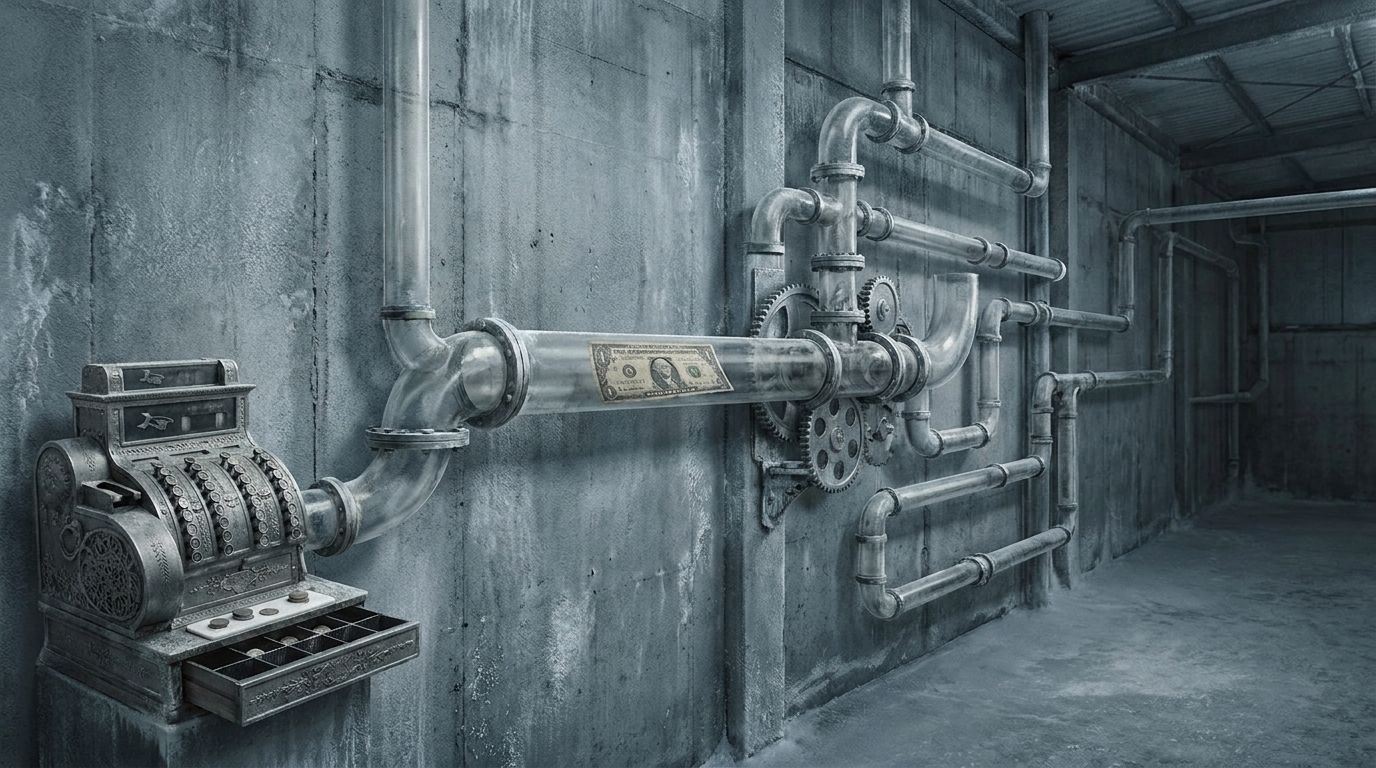
Most people have no idea what happens to their money after they pay for groceries, gas, or a streaming subscription. This explainer article traces the literal journey of a consumer dollar from checkout through corporate profit distribution, into PAC accounts, bundled campaign contributions, and ultimately to elected officials and the legislation they vote on. Using real company examples and FEC-verified data, we make the invisible financial-political pipeline visible - and show how tools like ShopHowYouVote.com let consumers short-circuit that pipeline at the source.
Every single day, millions of Americans swipe their debit cards or click checkout buttons without ever considering the complex, highly calculated political journey their money initiates. The moment a retail transaction occurs, your dollar enters an elaborate corporate financial apparatus that transforms everyday commercial revenue into highly potent political capital on Capitol Hill. This invisible pipeline operates through a series of seamless internal accounting steps. A portion of the profit generated from your purchase is routed into corporate treasury accounts, which are then utilized to fund corporate political action committees, cover the operational overhead of industry lobbying organizations, pay for high-access political fundraising events, or underwrite massive donations to dark-money advocacy networks that work to influence federal legislation. Exposing the mechanics of this hidden financial network is critical to understanding how corporate special interests dominate modern democratic systems. As traced in the Goods Unite Us report, "The Consumer-to-Campaign Finance Pipeline: How Your Purchases Fund Politics," corporate entities use highly sophisticated financial frameworks to maximize their political influence while deliberately shielding their activities from the everyday consumer. Through executive bonus matching programs and multi-candidate bundling committees, a simple dollar spent on everyday household staples is systematically aggregated with millions of others, converted into a targeted campaign contribution, and delivered directly to federal candidates who write the nation's regulatory frameworks, labor guidelines, and tax structures. By mapping this literal journey, conscious citizens can finally visualize the direct pipeline connecting their household expenses to national policy outcomes.
Understanding the hidden, highly structured pipeline that connects your retail transactions to national political campaign accounts can initially make you feel powerless against corporate influence. However, this entire financial infrastructure relies on one critical vulnerability: it is completely dependent on the continuous, unvetted influx of everyday consumer dollars. This means that individual citizens possess the ultimate tool to disrupt this system right at the source. By transitioning from passive spending to values-driven shopping decisions, you can deliberately cut off the flow of capital to corporations that fund hostile political agendas, effectively short-circuiting the corporate-to-political pipeline before your money ever enters a corporate treasury account. This proactive consumer intervention has deep systemic implications for the future of campaign finance accountability. As emphasized by the Brennan Center for Justice in their research on "Corporate Political Spending Transparency and the Limits of Disclosure," relying solely on legislative reforms to fix campaign finance often leads to political gridlock, making immediate consumer action an indispensable tool for democratic oversight. When you intentionally substitute a misaligned brand with a transparent, values-aligned alternative, you create an immediate, localized disruption in corporate fundraising capabilities. This disciplined habit strips resources away from special interest lobbying groups while actively rewarding ethical businesses that maintain strict boundaries around their political intervention. Realignment of your household budget turns your everyday economic choices into an unyielding shield for your civic values, proving that the checkout counter is one of the most effective tools for immediate political change.
1. Goods Unite Us - 'The Consumer-to-Campaign Finance Pipeline: How Your Purchases Fund Politics'
2. Brennan Center for Justice - 'Corporate Political Spending Transparency and the Limits of Disclosure'
3. FEC.gov - 'How Corporate Political Committees Raise, Bundle, and Spend Money'
4. OpenSecrets - 'Following the Money: A Guide to Corporate Political Funding Pathways'